
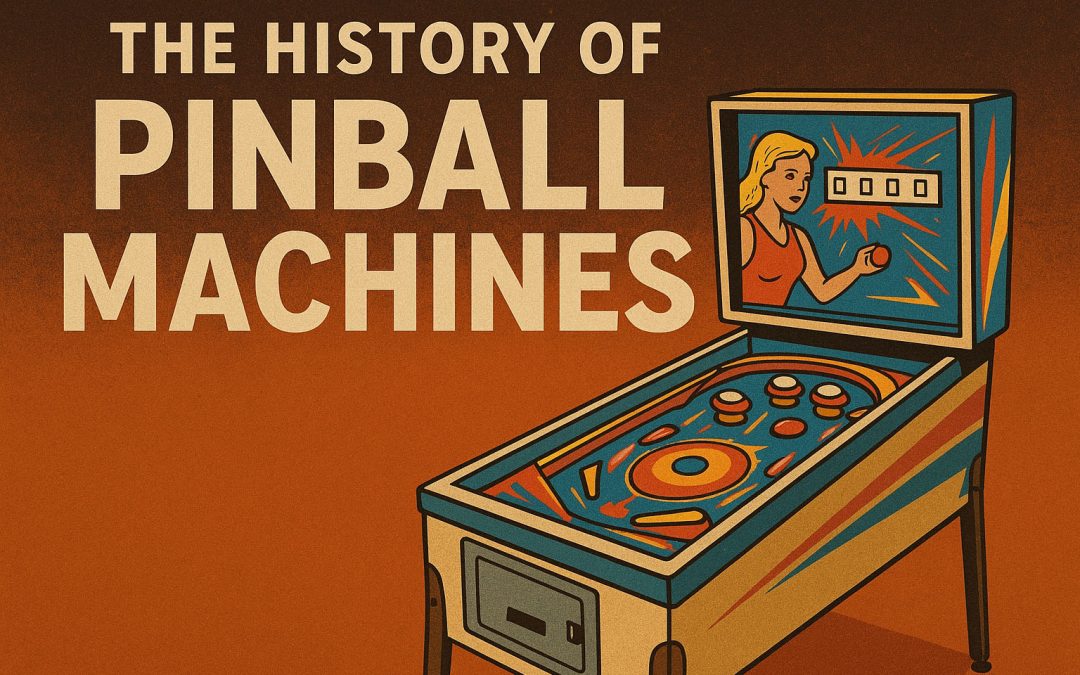
Pinball machines have been around a lot longer than most people think. That metal ball bouncing between flippers? It traces back centuries to outdoor lawn games in Europe. Here’s how pinball evolved from simple table games into the arcade icons we know today.
Bagatelle: Where It All Started

Patent model for the Montague Redgrave’s bagatelle c/o Wikimedia Commons
The story begins with bagatelle, an 18th-century French parlor game. Players used a stick to shoot balls across a table filled with pins and scoring holes (Princeton University, “Brief History of Pinball”). These tabletop games were essentially indoor versions of outdoor lawn games where balls were rolled into holes in the ground. The balls would roll down an inclined surface, bouncing off pins and landing in pockets with different point values. Those pins are actually how pinball got its name.
In 1871, British inventor Montague Redgrave made some important changes to bagatelle (Princeton University). He shrunk the table, replaced the balls with smaller marbles, and tilted the box at an angle. Most importantly, he added a coiled spring and plunger—features that are still standard in pinball machines today. Redgrave patented his invention as “Improvements in Bagatelle,” and it set the foundation for everything that came after (Wonderopolis).
The 1930s: Pinball Goes Coin-Operated
Modern pinball really took off in the early 1930s, and timing had a lot to do with it. The Great Depression was in full swing, and Americans desperately needed cheap entertainment. A penny or nickel could get you a few minutes of distraction from the economic hardship—and who couldn’t afford that? (KESQ News, “A Pinball Machine from the 1930s”)
In 1931, Arthur Paulin and Earl Froom created “Whiffle,” one of the first coin-operated, glass-covered pin games. They tested it in a local store, and when the machine took in $2.60 worth of nickels in a single hour, they knew they had something (Video Game Historian, “The History of Coin-Op Part 3”). They formed Automatic Industries and started booking orders for over 2,000 machines per month, though they struggled to manufacture fast enough to meet demand.
.jpg)
Baffle Ball c/o Wikimedia Commons
That same year, David Gottlieb’s “Baffle Ball” helped ignite the pinball craze (The Strong National Museum of Play). Gottlieb sold the table for about $16.50 and eventually moved 50,000 units, making it one of the best-selling machines of the era (Smithsonian Magazine, “What the Popularity of Fortnite Has in Common with the 20th Century Pinball Craze”).
Raymond Maloney’s “Ballyhoo” came next in 1932, also selling around 50,000 units (M&P Amusement, “Complete History of Pinball”). That success led Maloney to rename his company from Lion Manufacturing to Bally Manufacturing Corporation, and Bally became one of the biggest names in pinball.
By the end of 1932, over 100 pinball manufacturers were competing in the market—and at one point, as many as 145 companies were making machines, with the majority based in Illinois (M&P Amusement; KESQ News). Chicago became the center of pinball manufacturing. But the competition was fierce and unsustainable. By the mid-1930s, oversaturation had cut that number down to fewer than 14 companies (KESQ News).
Competition pushed innovation. The biggest change came in 1933 when Harry Williams invented “Contact,” the first battery-powered pinball machine (M&P Amusement). Electricity brought lights, sounds, bells, buzzers, and visible scoreboards—making the games far more exciting and appealing. These electro-mechanical features transformed pinball from a simple table game into a sensory experience.
Bumpers were added in 1936 when Bally introduced them to the playfield (The Pantagraph, “Pernicious Pinball”). And in 1935, Harry Williams invented the tilt mechanism to stop players from cheating by shaking and lifting the machines (Sparks Pinball Museum, “History of Pinball”). The tilt sensor was a response to players trying to cheat their way to high scores—and the prizes that often came with them.
The Pinball Ban
Things got complicated in the early 1940s. Because early pinball was based on luck rather than skill, and because betting on games became common, pinball got associated with gambling. Worse, the cash-based nature of the machines made them attractive to organized crime for money laundering. Many pinball machines were manufactured in Chicago factories that also produced slot machines, which didn’t help their reputation (The Pantagraph).
On March 17, 1937, Illinois Attorney General John E. Cassidy declared that all pinball machines should be outlawed as gambling devices, calling them “pernicious and dangerous to the public welfare” (The Pantagraph). The case eventually went to the Illinois Supreme Court, which ruled in 1942 that the ban applied only to “mechanical gambling devices,” leaving local officials to determine which machines would be banned.
In 1942, just weeks after the attack on Pearl Harbor, New York City Mayor Fiorello La Guardia declared war on pinball (Princeton University). He issued an ultimatum to the city’s police force stating that rounding up pinball machines would be their “top priority.” La Guardia believed that organized crime was behind the machines and that they “robbed the pockets of schoolchildren in the form of nickels and dimes given to them as lunch money” (Sparks Pinball Museum).
What followed were Prohibition-style raids. Police confiscated thousands of machines in a matter of days. La Guardia personally participated in the destruction, photographed swinging a sledgehammer while wearing a white suit and dramatically tipping machines over (Sparks Pinball Museum). The machines were smashed to pieces—police removed the wooden legs first, refashioning about 2,000 of them into billy clubs—then dumped the remains into the Hudson River (Smithsonian Magazine). The mayor destroyed over 11,000 machines in total (Smithsonian Magazine).
Other major American cities followed suit. Los Angeles and Oakland, California enacted their own bans. Chicago banned all pinball machines shortly after. It didn’t help that the materials used in pinball manufacturing—wood and metal—were seen as better suited for the emerging defense industry during World War II (The Pantagraph).
Pinball stayed illegal in New York until 1976. The industry organized a hearing where they needed to prove pinball was a game of skill, not chance. They brought in Roger Sharpe, a 26-year-old journalist who had written about pinball for GQ and the New York Times. Sharpe was the best player they could find.
The industry brought two machines to the hearing, one as a backup. But a skeptical councilman, concerned they had rigged the primary machine, demanded Sharpe use the backup—a machine he had never played before. Sharpe played surrounded by reporters, cameras, and councilmen, but he wasn’t making much headway with the anti-pinball coalition.
Then came the crucial moment. Sharpe pulled back the plunger to launch a new ball, pointed at the middle lane at the top of the playfield, and confidently stated that based on skill alone, he would get the ball to land through the middle lane. He released the plunger, and the ball did exactly what he said. Almost on the spot, the City Council voted to overturn the ban (Sparks Pinball Museum). Sharpe later worked as a licensing consultant for Williams pinball. Chicago would overturn its ban the following year.
1947: The Flipper Changes Everything
 The year 1947 was a turning point. Gottlieb’s “Humpty Dumpty” introduced the flipper, and this changed pinball from a game of pure chance to a game of skill (Princeton University). The machine featured six flippers—not two like modern games—and they faced outward. Players could now use buttons on the side of the machine to keep the ball in play and control their scores.
This was a fundamental shift. Before flippers, pinball was strictly luck-based. You pulled the plunger, watched the ball bounce around, and hoped it landed in a high-scoring pocket. There was no way to influence the outcome once the ball was in play. Flippers gave players agency. They could develop actual skills, learn timing, and directly affect their scores. This single innovation would eventually be the key argument that saved pinball from permanent prohibition decades later.
By 1948, Williams’ “Saratoga” refined the design, introducing jet bumpers and positioning the flippers at the lower end of the playfield where we still find them today (Digital Pinball Fans). The game was evolving rapidly.
The Solid State Era
As computer technology advanced in the late 1970s, circuit boards replaced the old relay systems. These “solid state” machines allowed for more complex rules, better sound effects, and deeper themes (Princeton University). The first pinball machine to use a microprocessor was Mirco Games’ “Spirit of 76” in 1975 (Digital Pinball Fans).
This technological shift came at an important time. The video game craze of the late 1970s and early 1980s was dealing a severe blow to pinball revenue as games like “Space Invaders” and “Pac-Man” flooded arcades. But the threat sparked creativity. Pinball manufacturers used solid-state technology to innovate and win back players (Wikipedia, “Pinball”).
Williams and Bally dominated this era with landmark innovations that still influence pinball design today. Williams’ “Gorgar” (1979) introduced speech—the first talking pinball machine (Princeton University). Williams’ “Space Shuttle” added ramps for the ball to travel around, creating flow and rhythm in gameplay. “Firepower” (1980) brought multiball to the solid-state era, allowing multiple balls in play simultaneously for higher scoring potential. And Williams’ “Black Knight” (1980) revolutionized the playfield with a multi-level design, introducing a second level with its own flippers (Wikipedia; Digital Pinball Fans).
These innovations changed how players experienced pinball. Suddenly, machines had personality. They talked to you, told stories, and offered complex gameplay modes. The “Black Knight” featured timer drop targets, magna save (a button that activates a magnet to save a draining ball), multiball, and what many consider some of the best artwork ever put on a pinball machine (Pinball Nirvana).
Bally’s “Xenon” (1980) was one of the first games with voice acting and featured blinking chase lights that added visual excitement (Wikipedia). Gottlieb’s “Black Hole” introduced a sunken lower playfield, creating three-dimensional gameplay. The competition to innovate was fierce, and it benefited players enormously.
The 1980s brought even more complexity. Machines featured multiple ramps, video modes, and interactive toys. Pat Lawlor designed many classic games during this period, including “FunHouse” in 1990, which had a talking animatronic head named Rudy that commented on gameplay and told players where to shoot (Princeton University). These machines weren’t just games anymore—they were experiences.
By this point, pinball machines had standardized features that players came to expect: spring-loaded plungers, flippers, slingshots, pop bumpers, and increasingly elaborate playfield designs. The machines featured drop targets (first introduced on Williams’ “Vagabond” in 1962), spinners, and complex scoring systems that rewarded skilled play (Digital Pinball Fans).
The Golden Age of Licensed Themes and Dot Matrix Displays
 The early 1990s represented pinball’s last and greatest golden age, and a single innovation made it possible: the dot matrix display (DMD).
In 1991, Data East’s “Checkpoint” became the first pinball machine to feature a dot matrix display (Wikipedia, “Checkpoint”). For the first time, a pinball display could show more than simple text scores—it could display animations, graphics, and tailored messages. The DMD was 128 pixels wide and 16 pixels high (Checkpoint used a “half-height” display), but designers achieved remarkable effects despite such limitations (Pinball Adventures).
Before the DMD, pinball machines showed scores on spinning reels or simple digital displays. The dot matrix changed everything. Designers could now tell actual stories, show players their progress, indicate which mode they were playing, and display available bonuses. Graphics and animations gave pinball machines personality and a lively feel (Wikipedia, “Checkpoint”). “Checkpoint” even included video mode minigames on its display—a first for pinball.
Williams quickly adopted and expanded the technology with full-height DMDs. This enabled the creation of increasingly complex rule sets and narrative-driven gameplay. Popular Mechanics included “Checkpoint” on a list of the top eight most innovative pinball machines of all time (Wikipedia, “Checkpoint”).
In 1992, Pat Lawlor designed “The Addams Family,” which became the best-selling pinball machine of all time with over 20,000 units sold (Princeton University). The game’s success came not just from its popular license but from its exceptional gameplay. The ramps and shots led naturally into each other, creating flow and rhythm. It nailed the fundamentals, and virtually every pinball machine since has taken design cues from it (Popular Mechanics).
The success of “The Addams Family” gave Williams/Bally enough financial security to let Lawlor create the machine of his dreams. In 1993, “Twilight Zone” was released—a messy, complex, frustrating, and immensely enjoyable machine (Popular Mechanics). Never before had a designer attempted to stuff so many toys and features into a single game.
Some of “Twilight Zone’s” features included a working gumball machine that dispensed pinballs onto the playfield, a miniature upper playfield with invisible magnetic flippers, a working clock that counted down game modes, and a fast-moving ceramic “power ball” (Princeton University; Popular Mechanics). The game is known for its incredible difficulty and its abundance of features. It has since developed a reputation as the most-modded machine, with collectors buying and selling even more toys for the already-crowded playfield.
“Medieval Madness” followed in 1997 and became another highly sought-after collector’s item (Princeton University). These machines represented pinball at its creative peak.
Other important machines from this era included “Bram Stoker’s Dracula” with its multi-multiball feature, where players could stack multiple play modes simultaneously for massive scores (Wikipedia). Games introduced “wizard modes”—special scoring modes reached after completing certain prerequisites, similar to final boss fights in video games (Wikipedia). Williams’ “Black Knight 2000” featured “The King’s Ransom” as its wizard mode, while “Twilight Zone” had “Lost in the Zone.”
Jackpots also became central to gameplay during the 1980s and 1990s. These scoring bonuses—often ranging from one to four million points—would accrue between games until someone scored them through complicated shot sequences (Wikipedia). The concept added layers of strategy and gave players long-term goals beyond just keeping the ball in play.
Video Games Take Over
The late 1990s were tough for pinball. Video games like “Space Invaders” and “Pac-Man” were taking over arcades (TazPin, “Pinball History”). Video game cabinets were smaller, required less maintenance, and offered more variety. Arcade operators increasingly chose them over pinball machines.
But the 1990s also saw the rise of home game consoles. The Super Nintendo Entertainment System launched in 1991, the PlayStation in 1995, and the Nintendo 64 in 1996. Gaming at home became more popular and convenient than visiting an arcade (Luckbox Magazine, “Replay: Pinball’s Flipping”). Why spend quarters at an arcade when you could play unlimited games at home?
Virtual pinball simulations also emerged during this period. Games like “Epic Pinball,” “Full Tilt! Pinball,” and the “Pro Pinball” series found marketplace success, starting a new trend for realistic pinball simulation (Wikipedia). These video versions became high enough quality for serious players to take notice.
Williams made one last attempt to innovate with Pinball 2000, which incorporated video monitors with gameplay animations. Their 1999 “Revenge From Mars” was successful—a hybrid that tried to merge pinball with video game aesthetics. But their second game was based on “Star Wars: Episode I.”
Shortly after its release, Williams permanently closed their pinball division on October 25, 1999 (Wikipedia). The company found greater profits in making gaming equipment for casinos. By 2000, Williams had withdrawn from the pinball market entirely, leaving only Stern Pinball as the sole manufacturer of new, original pinball machines (M&P Amusement).
Between 1955 and 1970, pinball had drawn in more money than Hollywood (Smithsonian Magazine). Now, the industry that once dominated entertainment was reduced to a single company.
Stern Keeps Pinball Alive
For over a decade, Stern Pinball was the only major manufacturer left. They kept releasing machines based on licensed themes like Monopoly, The Simpsons, Indiana Jones, and Metallica (Princeton University). Many of Stern’s designers were former Williams employees, so the expertise and institutional knowledge didn’t disappear—it just consolidated.
Stern became a lifeline for pinball enthusiasts, consistently releasing several titles per year and maintaining the industry single-handedly. Their machines kept the format alive and introduced pinball to new generations of players who might never have encountered it otherwise.
The Revival
Pinball didn’t die. Starting in the mid-2000s, smaller independent manufacturers began appearing (M&P Amusement). A revival was quietly brewing, driven by nostalgia for the games, increases in pinball-related social media, buzzworthy new game themes, and technological innovations.
In 2013, Jersey Jack Pinball released “The Wizard of Oz,” the first new US pinball machine not made by Stern since 2001 (Wikipedia). It was also the first American machine with a large color LCD in the backbox—a significant upgrade from the orange-glow dot matrix displays. The game featured widebody design (the first since 1994) and represented a new approach to pinball manufacturing with attention to detail and innovative engineering.
 Other new manufacturers followed. Spooky Pinball released “America’s Most Haunted” in 2014, and Heighway Pinball launched “Full Throttle” in 2015 (Wikipedia). More recently, Chicago Gaming Company has been producing remakes of classic machines like “Medieval Madness” and announced their first original title, “Pulp Fiction,” in 2023. Companies like Haggis Pinball in Australia have also emerged, creating innovative machines with cutting-edge technology (TazPin).
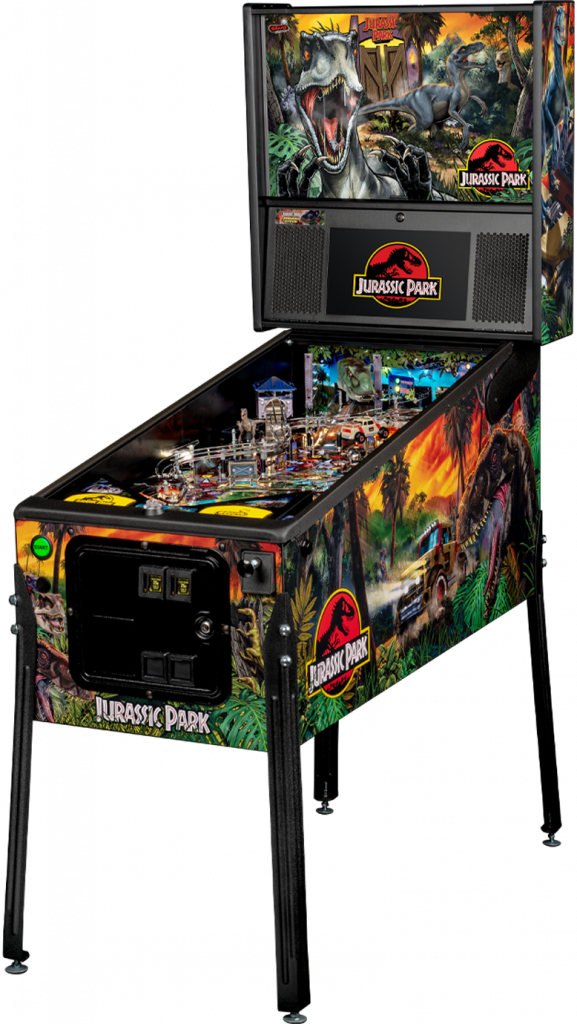
Modern pinball machines now feature LED playfield lighting that’s brighter and more energy-efficient than incandescent bulbs. LCD monitors in the backbox can display full-color videos and complex animations. Some machines include animatronics—Stern’s “Jurassic Park” features moving dinosaurs that react to gameplay (Betson). Bluetooth connectivity, built-in cameras, and even smartphone controls have made their way into pinball design (Princeton University).
Color DMD modifications have become popular in the collector community. These aftermarket upgrades replace the standard orange dot matrix displays with color screens capable of displaying the same information but in vivid color (Pinball Adventures).
The COVID-19 pandemic unexpectedly boosted the industry further. Lockdowns pushed people to seek home entertainment, and pinball—already trending upward—saw demand increase dramatically. In the home and collector market, supply couldn’t keep up with demand (Luckbox Magazine).
Barcades—bars combined with arcade games—have popped up in cities across the globe, creating new venues for pinball (Luckbox Magazine). These spaces appeal to adults who grew up with the games and want to share them with their children, creating cross-generational interest.
Pinball also receives attention at dedicated arcades, museums, and competitive tournaments. The International Flipper Pinball Association hosts championship series events that draw players from around the world. The Pinball Hall of Fame in Las Vegas houses restored machines from the 1930s through the present day in a 27,000-square-foot building near the famous “Welcome to Fabulous Las Vegas” sign (Discover Vintage America).
The game’s appeal transcends generations. People walk into these museums and arcades, see a machine they’d forgotten about, and memories come flooding back. That nostalgia factor, combined with the tactile nature of physical gameplay—something that virtual platforms can’t replicate—has fueled the resurgence.
But at their core, modern pinball machines still have that steel ball, those flippers, and that satisfying crack when you nail a perfect shot. The fundamentals that made the game compelling in 1947 remain compelling today.
The game that started as people rolling balls into holes in the ground has become a mechanical and electronic marvel. After 90+ years of coin-operated play, pinball is still here—still blinking, still ringing, and still drawing in players of all ages. As Gary Stern, head of Stern Pinball, has said: “Pinball has been a part of the human experience for over 300 years. There’s nothing that can offer the same type of immersive entertainment experience with the hottest themes as pinball” (Luckbox Magazine).
The silver ball keeps rolling.
Looking for your own pinball machine? At Pinballs.com, we’ve been selling and servicing pinball and arcade games for over 53 years. With 35,000+ square feet of space and over 600 machines in stock, our expert technicians can help you find the perfect game for your home or business. Browse our selection or talk to our team about what machine fits your needs and budget.
Sources
- Princeton University, Joseph Henry Project. “Brief History of Pinball.” https://commons.princeton.edu/josephhenry/brief-history-of-pinball/
- The Strong National Museum of Play. “Pinball.” https://www.museumofplay.org/toys/pinball/
- M&P Amusement. “The Complete History of Pinball Machines.” https://mpamusement.com/blogs/blog/the-complete-history-of-pinball-machines
- Sparks Pinball Museum. “History of Pinball.” https://sparkspinballmuseum.com/history-of-pinball-1
- TazPin. “Pinball History.” https://www.tazpin.org/learn/pinball-history/
- Wonderopolis. “When Was Pinball Invented?” https://wonderopolis.org/wonder/when-was-pinball-invented
- Wikipedia. “Pinball.” https://en.wikipedia.org/wiki/Pinball
- Wikipedia. “Checkpoint (pinball).” https://en.wikipedia.org/wiki/Checkpoint_(pinball)
- Digital Pinball Fans. “Machines That Broke the Mold.” https://digitalpinballfans.com/threads/machines-that-broke-the-mold.3184/
- Pinball Nirvana. “Your Top-10 Pinball Machines from All Decades.” https://pinballnirvana.com/forums/threads/your-top-10-pinball-machines-from-all-decades.4586/
- Video Game Historian. “Historical Interlude: The History of Coin-Op Part 3, Pinball.” https://videogamehistorian.wordpress.com/2015/04/23/historical-interlude-the-history-of-coin-op-part-3-pinball/
- Smithsonian Magazine. “What the Popularity of Fortnite Has in Common with the 20th Century Pinball Craze.” https://www.smithsonianmag.com/innovation/popularity-fortnite-common-20th-century-pinball-craze-180970721/
- The Pantagraph. “Pernicious Pinball Once Banned as Gambling, Sparked 1951 McLean Co. Vice Raid.” https://pantagraph.com/news/local/history/article_ccab0306-9567-45d2-9f29-393b66772ded.html
- KESQ News. “A Pinball Machine from the 1930s Made Its Way Back to Where It Was Made.” https://kesq.com/news/national-world/2021/04/26/a-pinball-machine-from-the-1930s-made-its-way-back-to-where-it-was-made/
- Popular Mechanics. “Top 8 Most Innovative Pinball Machines of All Time.” https://www.popularmechanics.com/technology/a3461/4276614/
- Pinball Adventures. “How Pinball Machines Evolved.” https://www.pinballadventures.com/how-pinball-machines-evolved/
- Luckbox Magazine. “Replay: Pinball’s Flipping.” https://issuu.com/luckbox/docs/2206_luckbox_issuu/s/15897032
- Betson. “The Founding of the Flippers: Your Guide to the History of Pinball.” https://www.betson.com/history-of-pinball/
- Discover Vintage America. “Pinball Wizard: Pinball Machines Stay in the Game Even 100 Years After Initial Release.” https://www.discovervintage.com/cover/pinball-wizard-pinball-machines-stay-in-the-game-even-100-years-after-initial-release/